
A Fallen Power: a fragment of Goliath’s arm from the Buchach Town Hall
Creation
The limestone massif is a surviving fragment of the expansive, monumental composition “David and Goliath”, created by the master Johann Georg Pinsel in collaboration with the architect Bernard Meretyn in the 1750s. Intended to adorn the exterior balustrade of the Buchach Town Hall, this multi-figure group embodied the pinnacle of Baroque expression. Every anatomical detail was subordinated to a single impulse of dramatic conflict. The figure of Goliath in this scene served not merely as a pedestal for the victor, but personified the scale of the chaos that had been overcome. This called for a particular sense of monumentality and the hyperbolisation of forms.Description
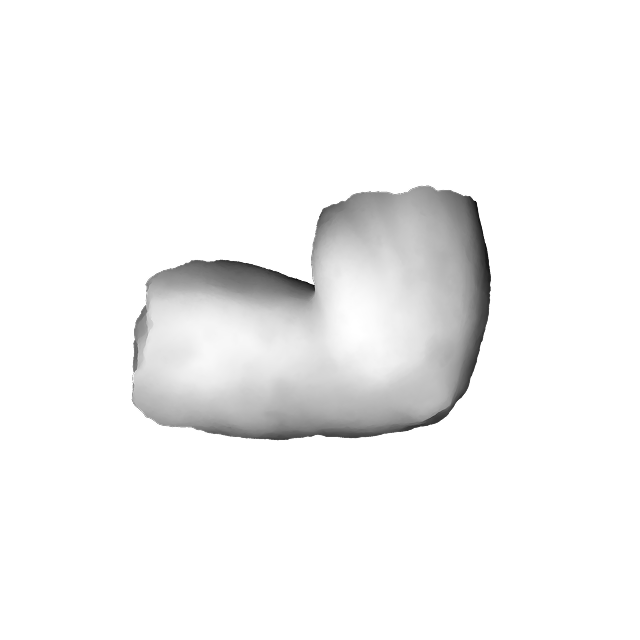
This modern photo documentation reveals a part of the Baroque colossus’ body – a fragment of its bent arm. Despite severe weathering, deep erosion and cavities in the limestone, the fragment continues to radiate the immense tectonic tension imbued in it by the artist over two centuries ago.
Pinsel’s signature “hewn” plasticity is unmistakably recognisable in it. Instead of the classical fluidity of lines, the master deliberately modelled the volumes using sharp, angular planes.
The bend in the limb forms a sharp, almost geometric crease. In it, one can clearly discern the prototype of Cubist fragmentation of form, which was a century and a half ahead of its time. Pinsel exaggerated Goliath’s musculature to convey either the giant’s monumental nature or a death throe: the transitions between the bicep and the forearm are rendered as powerful three-dimensional structures.
Goliath’s hand has completely lost its anthropomorphic details: fingers, skin texture, and the relief of the veins.
Under the influence of wartime destruction and relentless atmospheric forces, it has been transformed into a monumental Baroque “non-finito”. The surface of the limestone has become porous, marked by dark layers of time, making this masterpiece resemble a natural formation – a wild rocky ledge.
This fragment stands as a self-contained visual manifesto, in which a battered stone speaks louder than the original about the drama of human history, the fragility of culture and the inexorable force of time.
- A fragment of Goliath’s arm. mid-18th century.
- Limestone.
- Size: .
- Provenance: Buchach Town Hall, Ternopil region.