
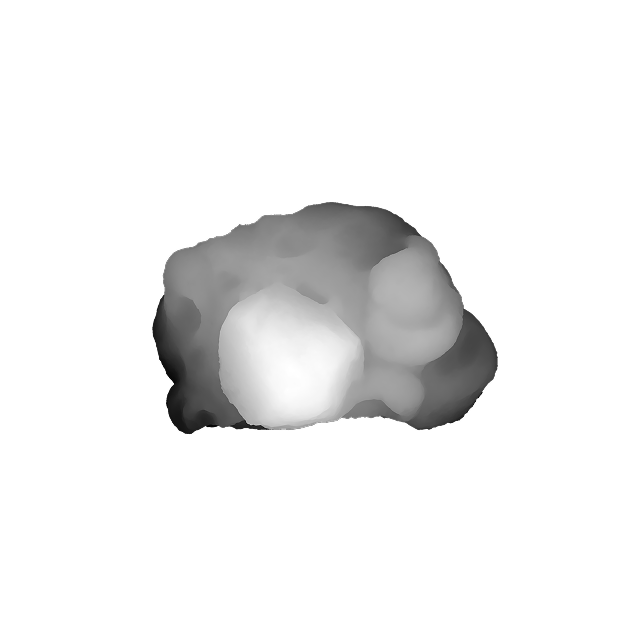
A fragment of Goliath’s head from the Buchach Town Hall. A stone within a stone
Creation
This sculptural stone fragment forms part of the monumental sculptural group “David and Goliath”, created in the 1750s to adorn the balustrade of Buchach Town Hall. This ensemble was the result of a unique collaboration between the architect Bernard Meretyn and the sculptor Johann Georg Pinsel. The figure of the fallen giant served as both a compositional and symbolic pedestal for the triumphant David. It embodied the essence of Baroque drama – the defeat of brute force by spiritual victory.Description
Archival photographs from the early 20th century clearly show the original position of this fragment within the monument’s overall structure. Goliath was lying on his back, struck down by a precise blow. His massive head, with features grotesquely distorted in agony, was turned towards the viewer. These old photographs reveal just how powerful the master’s Baroque expression was: Pinsel carved the giant’s hair in the form of heavy, deep and rhythmically curled locks, symbolising a chaotic, unbridled force of nature.
Contemporary photo documentation reveals to us a unique, profoundly dramatic artefact. What we see before us is a preserved fragment of Goliath’s limestone locks. At its centre, the key evidence of the biblical battle is frozen forever: the stone hurled from the sling of the future King of Judah.
Even through the significant weathering and cavities left by man-made disasters and the relentless passage of time, Pinsel’s unmistakable hand can still be discerned. The sculptor did not merely imitate strands of hair – he constructed them as expressive, almost architectural forms with deep relief. The rounded, naturally smooth river stone embedded in the giant’s forehead contrasts with the chiselled, sharply defined curls surrounding it.
Today, stripped of its overall anatomical context, this fragment is perceived as a self-contained object. The texture of the limestone, worn down by erosion, has transformed the Baroque detail into an expressive abstraction. The stone within a stone – David’s weapon, lodged in the flesh of his enemy – has become a metaphor for time itself. It stands frozen amidst the ruins, transforming a moment of biblical triumph into an eternal monument to the fragility of human genius.
- A fragment of Goliath’s head. mid-18th century.
- Limestone.
- Size: .
- Provenance: Buchach Town Hall, Ternopil region.