
David’s head from Buchach Town Hall. Traces of time
Creation
The sculpted head comes from the monumental stone composition “David and Goliath”, which once adorned the attic of the famous Buchach Town Hall. This sculpture was probably created in the 1750s, when Johann Georg Pinsel, already an established master, was actively working on the decoration of this building. The Buchach Town Hall became one of the most significant projects in the artist’s career, where he was able to fully realise his talent in monumental sculpture.Description
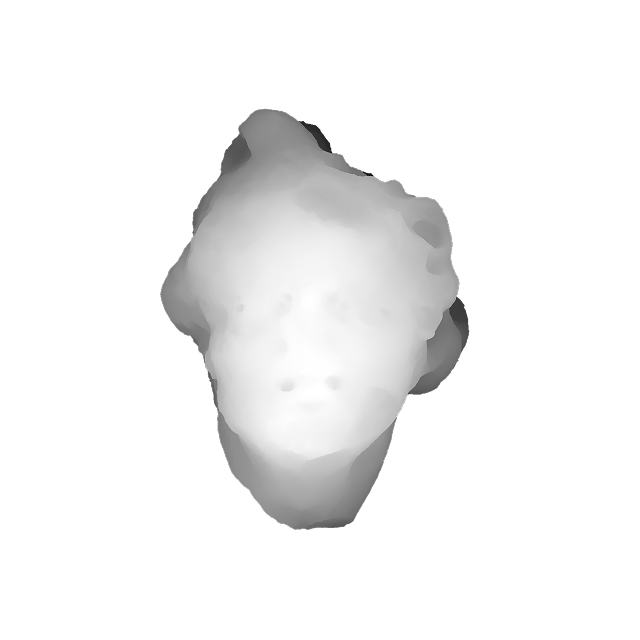
Today, David’s head is merely a fragment of what was once a magnificent and dynamic multi-figure composition. Despite the catastrophic damage inflicted by time and external factors, this fragment still bears a distinct imprint of Johann Georg Pinsel’s expressive style. Even in such a battered state, one can still make out the tense, characteristic turn of the entire figure and its forward-looking gaze. Through the missing details, one can discern the characteristic “hewn” quality of the forms, which echoes the master’s unique geometric style. In this, modern researchers see a precursor to early 20th-century Cubism. The surviving sculpture allows us to imagine how masterfully Pinsel combined profound psychological insight and anatomical precision of the body with the turbulent, almost aggressive dynamism of the drapery.
Presumably, to achieve maximum expressiveness, the artist painted the exposed areas of the face and hair realistically, using polychromy. He decorated the surrounding elements of the robe with gilding. Unfortunately, not a trace remains of this Baroque polyphony of colours: the weathered stone now resembles an abstract form rather than a portrait of a biblical hero. It stands as a silent reminder of the fragility of the world’s cultural heritage.
A retrospective analysis of archive photographs from the early 20th century allows us to fully reconstruct the artist’s original vision. The old photographs show that the figure of the young David seemed to resonate with inner energy. His body was frozen in a sharp, almost acrobatic twist. His left foot rested triumphantly on the fallen giant Goliath, whilst his right arm was raised behind him in preparation for a victorious blow. His head, sharply turned and thrown back, revealed to the viewer an expressive, determined profile, framed by strands of hair resembling turbulent tongues of flame. The master’s unique style was evident in every line: a bold contrast between the chiselled, geometric folds of the clothing and the impeccably modelled musculature of the tense body.
Comparing these historical images with modern photo documentation, we can see the tragic transformation of a masterpiece of the world Baroque into an unrecognisable artefact. The man-made disasters of the 20th century – in particular, the destruction of the town hall in the flames of war – as well as the relentless the effects of natural forces have almost completely erased the artist’s touch from this fragment. The once exquisitely carved facial features, the sculpted curls and the taut veins on David’s neck have turned into a solid, crumbling mass of limestone. It has come to be associated more with a natural stone nugget or an abstract sculpture of late modernism. Instead of refined Baroque expression, we are presented with a porous texture, pitted with deep cavities and cracks. It has almost lost its anthropomorphic features.
This striking contrast between the intellectual heights of Baroque thought, captured in old photographs, and the present-day, depersonalised chunk of stone elevates David’s head above the status of a mere museum exhibit. It is now an eloquent symbol of art’s vulnerability in the face of the relentless passage of time and human neglect.
- David’s head. mid-18th century.
- Limestone.
- Size: .
- Provenance: Buchach Town Hall, Ternopil region.