
Cherub: a Glance at Heavenly Freedom
Creation
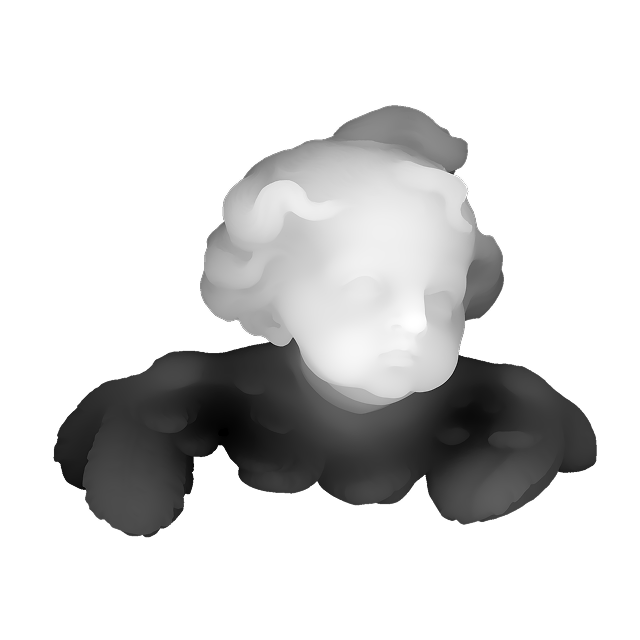
This wooden fragment depicting a cherub comes from the grandeur high altar of the Church of the Immaculate Conception of the Blessed Virgin Mary in Horodenka. The church was built between 1745 and 1769 through the creative collaboration of the architect Bernard Meretyn and the sculptor Johann Georg Pinsel. Mykola Vasyl Pototskyi, the starosta of Kaniv, sponsored the project. The master carved this sculptural detail during the height of his expressive style – approximately between 1750 and 1755. During the Soviet era, the church’s unique Baroque decoration was destroyed. Thanks to expeditions by Ukrainian art historians, this fragment has been preserved for future generations. Today, this fragment stands as its own entity, possessing profound artistic and historical significance.Description
The front part of the cherub is covered in authentic white levkas. It imitates not so much the texture of fine marble as the very sincerity and purity of white clouds, heavenly purity and earthly innocence. All this harmonises subtly with the dedication of the church itself.
This work depicts an expressive state of the subject, which contrasts with the sombre altar figures. The angel’s head is rapidly thrown back and sharply turned to the side. The gaze of his wide-open eyes is directed almost vertically upwards, towards the heavens. His half-open lips are frozen in a state of religious rapture or prayerful ecstasy. Particular attention is attracted by the way Pinsel models the line of the chin and the tense neck: this steep angle creates the illusion of lively, fleeting movement. Particular attention is attracted by the way Pinsel models the line of the chin and the tense neck: this steep angle creates the illusion of lively, fleeting movement. This is not merely a frozen pose, but rather an echo of a silent dialogue with the other cherubs on the altar – a passionate invitation to a heavenly ascent and freedom, which illusorily recreates the perfection of God’s archipelago of heavens. The wavy locks of hair framing the face flow smoothly into the massive wing elements, which seem to support the head in flight.
The rear of the sculpture reveals the technical and dramatic aspects of the monument. In contrast to the smooth facade, the back of the head and the wings at the rear appear as a roughly finished block of wood. This exposes the very nature of the material and the marks left by the artist’s chisel. The metal mounting hook and residual rods, which were used to secure the angel to the large altar, are clearly visible. The uneven chips along the edges of the levkas and the exposed wood on the reverse emphasise the monument’s fragility, whilst serving as a reminder of its long and difficult historical life.
- Cherub. 1752-1755.
- Limewood, white paint.
- Size: 36,5х48,5х24,5.
- Location: Johann Georg Pinsel Museum in Lviv. LAG inv. no С-І-1083.
- Provenance: the high altar of the Missionary Fathers’ Church of the Immaculate Conception of the Virgin Mary in Horodenka, Ivano-Frankivsk region.