
The Cherub from the Horodenka Altarpiece. The Chiaroscuro of the Baroque Style.
Creation
This wooden fragment depicting a cherub comes from the high altar of the Church of the Immaculate Conception of the Blessed Virgin Mary in Horodenka. The church, built between 1745 and 1769, was the culmination of the collaboration between the architect Bernard Meretyn and the sculptor Johann Georg Pinsel. Its construction was financed by Mykola Vasyl Pototskyi, the starosta of Kaniv. The sculpture was carved during the master’s creative heyday – in the first half of the 1750s. During the Soviet era, the church’s unique Baroque decoration was destroyed. However, thanks to expeditions by Ukrainian art historians, this fragment has been preserved for future generations. Today, it stands as a standalone artefact of profound artistic and historical significance.Description
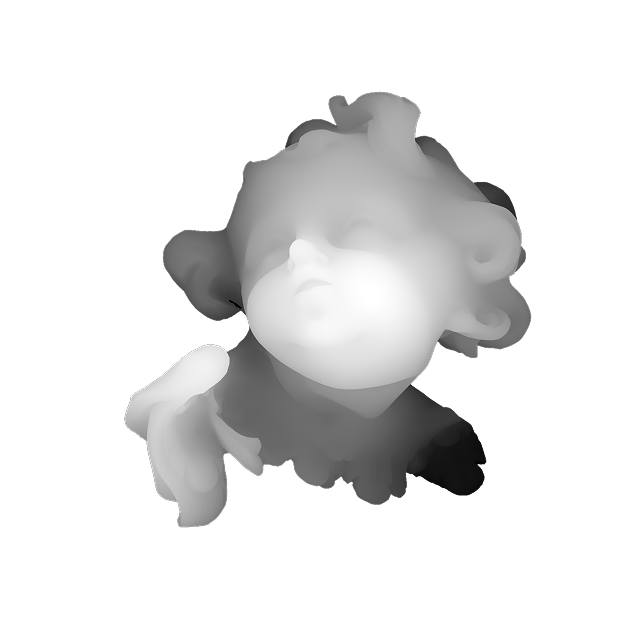
The work represents a unique style of sculpture, in which a round sculpture flows organically into a two-dimensional relief. It is designed to be viewed from a fixed vantage point within the altar’s majestic structure. The main distinctive feature of this cherub is the monolithic, almost architectural tectonics of its construction. This is best demonstrated from the frontal view – the angel’s face is tilted downwards and turned somewhat three-quarters. This is best demonstrated from the frontal view – the angel’s face is tilted downwards and turned somewhat three-quarters. This creates a remarkable sense of inner concentration. The massive, rounded contours of the cheeks and the soft chin are covered with a thick layer of snow-white levkas. The patina – light, natural flecks and the wear and tear of time, scattered across the forehead and cheeks – is of particular artistic value; it clearly emphasises the monument’s noble age and the absence of later, crude interventions.
The sculptural treatment of the cherub reveals the complex asymmetry of Pinsel’s Baroque thinking. The angel’s hair does not merely frame the forehead, but curls into tight, almost graphic, snail-like curls with deep internal undercuts. One wing rises rapidly upwards, creating a vertical focal point. The other unfolds horizontally, forming a sweeping visual foundation. This interplay of volumes gives rise to a shifting dynamic of light and shadow, full of inner life.
Looking at the sculpture from the rear offers a unique opportunity to peer into the master’s “creative laboratory”. The rear section is completely free of foundation and reveals the pure, bare wood. Here, one can see the broad, bold cuts made with a flat chisel, with which the sculptor shaped the figure’s base and adapted it to the plane of the altar structure.
- Cherub. 1752-1755.
- Limewood, white paint.
- Size: 34х32х23.
- Location: Johann Georg Pinsel Museum in Lviv. LAG inv. no С-І-1087.
- Provenance: the high altar of the Missionary Fathers’ Church of the Immaculate Conception of the Virgin Mary in Horodenka, Ivano-Frankivsk region.