
Saint Joachim of Horodenka
Creation
The sculpture of Saint Joachim comes from the high altar of the Church of the Immaculate Conception of the Virgin Mary and the monastery of the Missionary Fathers in Horodenka. The renowned master Johann Georg Pinsel created this masterpiece between 1752 and 1755. The Baroque church itself was built between 1745 and 1769 as a joint project under the direction of the architect Bernard Meretyn.Description
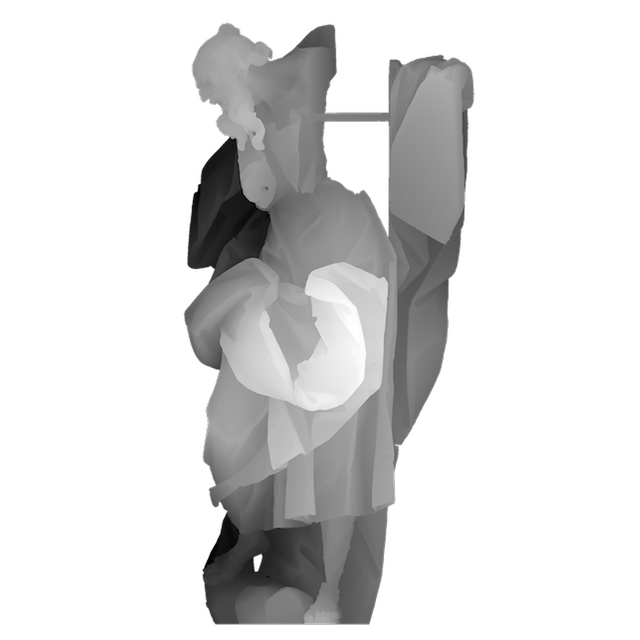
The figure of Saint Joachim is frozen in a profound, dramatic movement. His head, covered with thick locks of grey, curly hair, is bowed in sorrow and deep contemplation. Joachim’s gaze is directed downwards and filled with inner grief.
The saint’s body is hidden under massive, sharp-edged robes. Pinsel has rendered them in his distinctive, expressive style – with deep, sharp folds and dynamic, almost geometric pleats in the fabric. This expressive rendering of the clothing creates a powerful interplay of light and shadow and further emphasises the monumentality of the figure.
Pinsel offers a perceptive interpretation of the figure of Joachim, endowing him with distinct psychological traits characteristic of old age, paternal self-sacrifice and spiritual dignity. The contrasting sculptural volumes, the intricately carved strands of the beard, the sharp, almost graphic lines of the drapery and the saint’s expressive posture – all this brings this wooden sculpture close to the finest examples of European Baroque and demonstrates the master’s unique style.
Originally, the sculpture of Saint Joachim was situated in the right-hand wing of the church’s high altar. As evidenced by old photographs, the saint was depicted in a majestic and expressive pose. His right arm was bent at the elbow and raised to chest level, with his palm open. This created the impression of a lively conversation or a prayerful address. His left hand held the edge of his heavy cloak, fixing its dynamic movement. The saint’s robes cascaded in sharp, uneven, and deeply cut folds, which created a striking play of light and shadow even in the semi-darkness of the church. The fabric literally “bubbled” around the figure, creating the illusion of a gust of wind.
Photographs from the early 20th century show that the sculpture was intact – the facial features, the sumptuous curly beard and the majestic contours of the figure were all perfectly preserved. The solid, gleaming gilding on the cloak stood in stark contrast to the realistically painted exposed parts of the body (Carnation) and the hair.
The passage of time and the tragic events of the Soviet period have left deep traces of destruction on the monument. The sculpture has suffered significant damage: the hands have been completely broken off, fragments of the expressive folds in the cloth have been lost, and the wooden base is covered with cracks. Furthermore, the original, authentic polychrome layer and gilding that once covered the saint’s robes have been lost. As a result, the bare, unpainted wood is now visible.
Historical photographs show that the current “cubist” and stark appearance of Joachim’s exposed timber is merely the result of tragic destruction. Pinsel’s original concept was based on the glow of gold, the integrity of the lines and the theatrical expressiveness of the gestures, which harmonised perfectly with Bernard Meretyn’s architecture.
- St. Joachim. 1752-1755.
- Limewood, relict areas of levkas, lost polychrome.
- Size: 280.
- Location: Johann Georg Pinsel Museum in Lviv. LAG inv. no С-І-1635.
- Provenance: the high altar of the Missionary Fathers’ Church of the Immaculate Conception of the Virgin Mary in Horodenka, Ivano-Frankivsk region.